
Muskingum Projected Versus Actual Release
A projected date is a forecast based on the sentence and information available when the agency calculates it. An actual date records what occurred. Ohio's state offender detail combines two concepts under the label Expected Release Date/Parole Eligibility Date. The official definition says the field may be a projected release date or a date pending parole consideration. A future date on an Incarcerated record therefore does not prove that an exit will happen on that day.
For actual state departure, read the complete ODRC Status and Parole/Release Detail. The detail is shown for a person who has been released or paroled, while an incarcerated record has no such release detail. APA Supervision describes state community supervision and is not final discharge. Released is broader than ordinary sentence completion, so quote its full reason. Verified ODRC records included judicial release and death, which have very different meanings.
A pretrial Muskingum County detainee usually has no calculated ODRC date. The local court may order recognizance or bond, modify conditions, dismiss a charge, or issue another order. A detainer or warrant can still prevent a community exit. The sheriff's release sheet supplies the actual end of the county custody episode.
Find Muskingum County Release Dates
Choose the search route from the custody history. A Muskingum County felony sentence that led to prison belongs in the ODRC Offender Search. A short local sentence or pretrial booking belongs with the Muskingum County court and sheriff. A person transferred from the county jail to ODRC was released by the sheriff to another custodian, not to the community.
- Identify whether the person is in county jail, ODRC custody, or a different system.
- For ODRC, search the A, R, or W-prefixed offender number when known.
- Otherwise search the name and set County of Commitment to Muskingum.
- Open the matching detail and compare name, offender number, photo, offense, admission, and county.
- Read Status, the full status reason, Expected Release Date/Parole Eligibility Date, and Parole/Release Detail together.
- For county custody, read the sentencing or release order and request the sheriff's release sheet.
County of Commitment means the county tied to the state sentence. It does not show where a person is housed. ODRC can assign a person sentenced from Muskingum County to an institution anywhere in Ohio. A person who only posted bond or served a local jail term may never have an ODRC record.
The ODRC search and release-detail capture illustrates the status controls and the state detail used in this process.
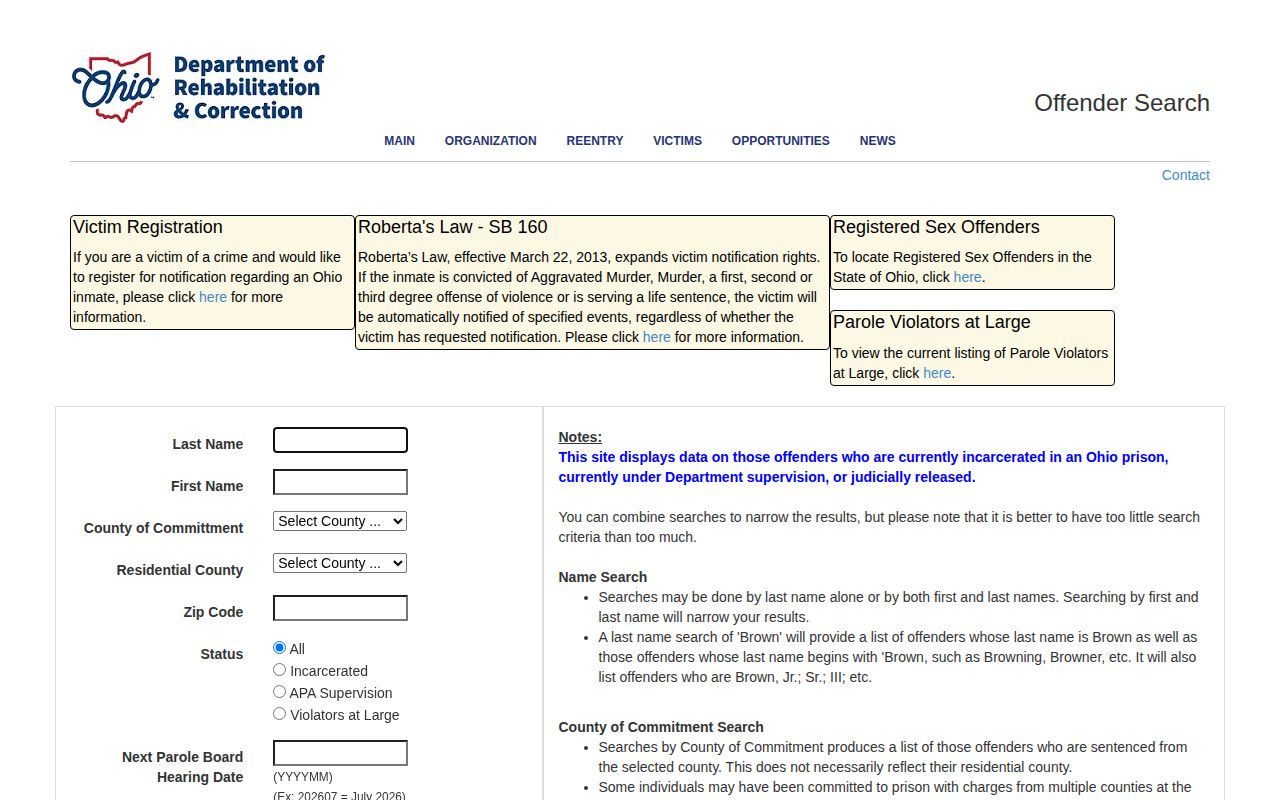
The visible state fields must still be matched to the right person and interpreted by their exact labels.
Muskingum ODRC Release Date Labels
Several ODRC date labels serve different purposes. PRD means Projected Release Date. POA means parole on or after. The expected or eligibility field can be either a calculated end point or the date from which parole may be considered. A hearing date is not a grant, and parole eligibility is not release. The underlying sentence and the current status decide how each field should be read.
| ODRC label | Meaning | What it does not prove |
|---|---|---|
| Expected Release Date/Parole Eligibility Date | Projected release or date pending parole consideration | Actual departure |
| PRD | Projected Release Date | A guaranteed calendar event |
| POA | Parole on or after | That parole was granted |
| Parole/Release Detail | State release or parole event information | Completion of all later supervision |
| Expiration of Supervision Term | Maximum APA control date from the governing source | Prison exit date |
| TC/TT Sentence Expiration | Projected end tied to a halfway-house placement | Unsupervised freedom |
ODRC's release and parole definitions explain that Transitional Control is closely monitored community confinement before the ordinary term expires or parole begins. It is governed by Ohio law and should not be described as an unrestricted discharge.
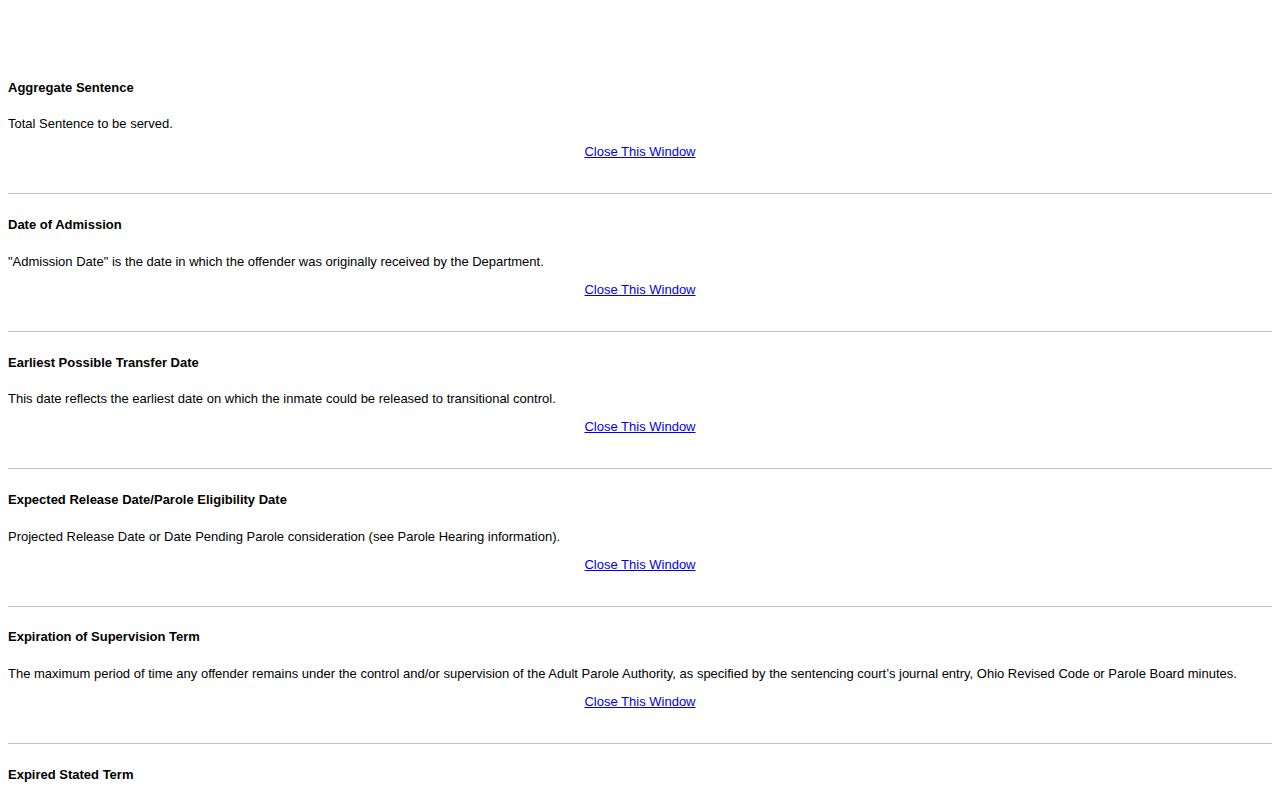
The captured definitions show why a single displayed date cannot answer every release question.
Note: Quote the full ODRC status reason because Released alone can describe more than one kind of event.
Ohio Credit Changes Release Dates
Ohio's current earned-credit framework appears in Ohio Revised Code 2967.194. For eligible people under the current framework, productive participation can provisionally earn one or five days for each completed month. Successful completion of a second program or activity can add up to five more days. Certain qualifying diploma or program completions can yield ninety days or ten percent of the stated term, whichever is less.
Ordinary aggregate participation and completion credit, apart from the special statutory subsection, cannot exceed fifteen percent of the stated prison term. That ceiling is sometimes reduced to an “85 percent” slogan. It is not a universal promise that every Ohio prisoner leaves after serving exactly that share. Eligibility, sentence type, conduct, participation, completion, and statutory exclusions matter. Credit can be denied or withdrawn for rule violations.
The law excludes non-reducible terms and specified offense or sentence categories. It also addresses how credit applies to definite terms and qualifying minimum or maximum terms under Ohio's indefinite-sentence structure. The prior statute, ORC 2967.193, belongs to the historical framework and should not be applied to every current record.
The official earned-credit statute capture provides the source for these limits.
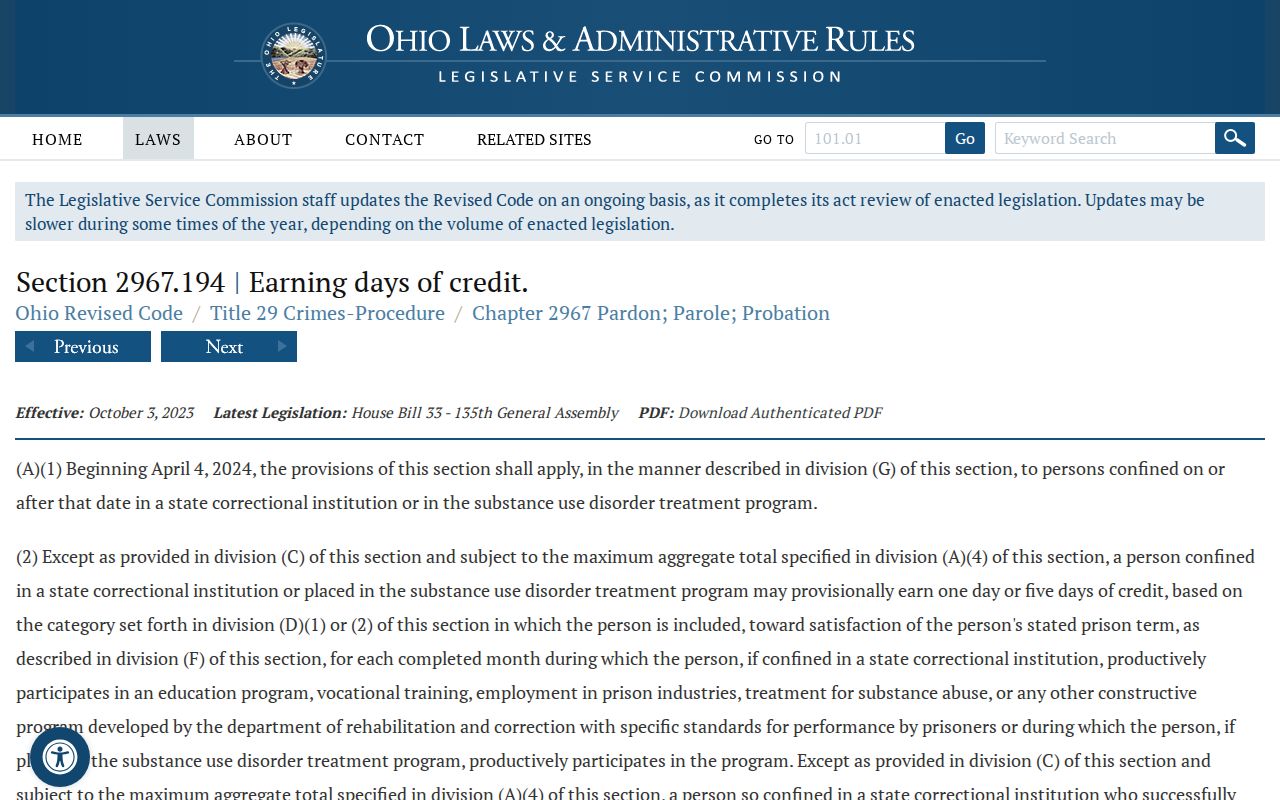
The statute supports a case-specific calculation, not a shortcut based only on the length of the announced sentence.
Muskingum Jail Credit and Sentences
Time already spent in qualifying confinement is a separate issue. ORC 2967.191 governs credit for qualifying confinement while awaiting trial or delivery. The sentencing court's entry should state jail-time credit. Use that entry rather than estimating days from an arrest date, a booking screen, or memory. Transfers, multiple cases, and periods tied to other holds can make a simple calendar count wrong.
The court record also shows whether terms run concurrently or consecutively, whether a sentence was corrected, and whether an appeal or later order changed the judgment. Effective sentence date, net sentence, offense, and jail-time credit should be reviewed together on an ODRC detail. No Muskingum-specific county-jail good-time formula was verified in the research. County release dates should not be calculated by copying the ODRC PRD method.
The official prior-confinement credit page shows the law behind the court-awarded credit.
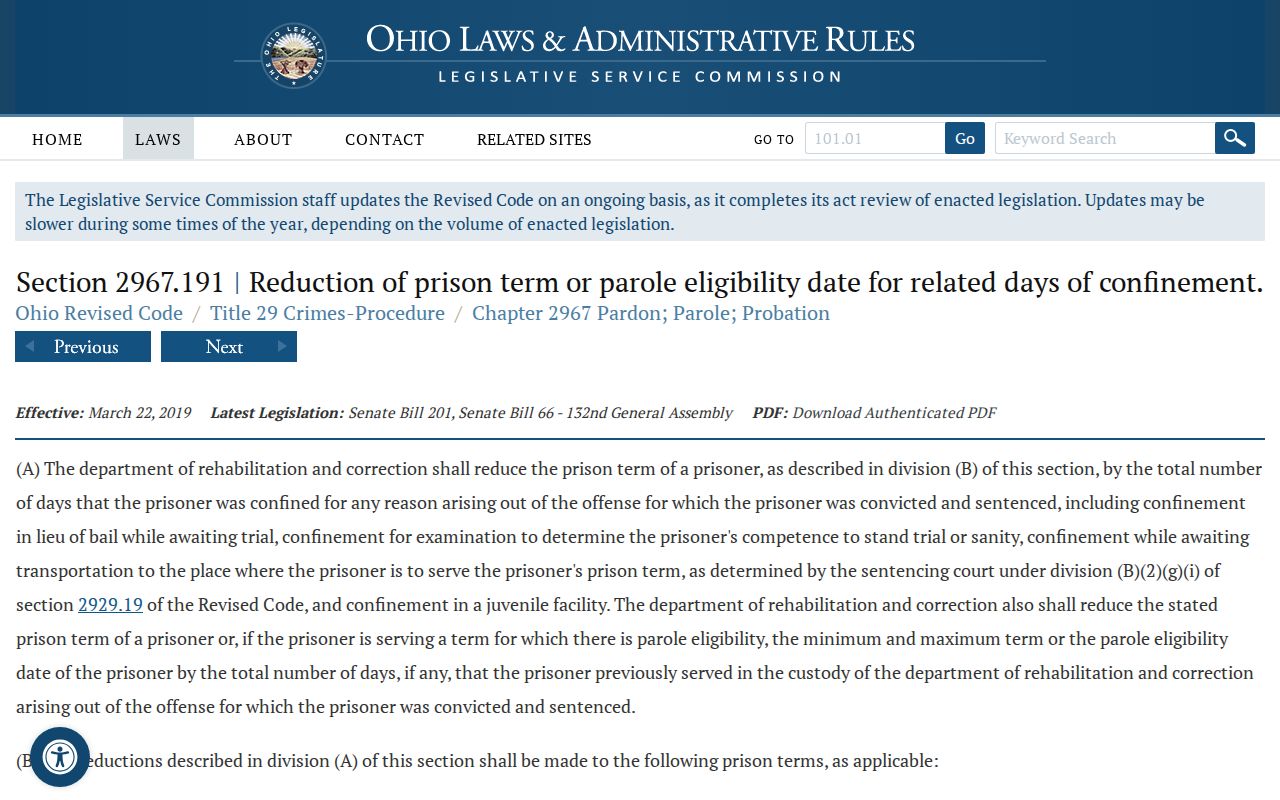
The court entry remains the practical record for the amount applied in an individual Muskingum County case.
Why Muskingum Release Dates Change
A release forecast can move because law, conduct, a new order, or another custodian changes the inputs. Judicial release under ORC 2929.20 can authorize an earlier court-controlled exit. Transitional Control under ORC 2967.26 can move an eligible person to closely monitored community confinement. Parole decisions under ORC 2967.13 depend on the sentence and governing subsection. Post-release control under ORC 2967.28 concerns supervision after prison and is not extra incarceration unless a violation or sanction changes custody.
| Factor | Possible effect |
|---|---|
| Earned credit | Eligible participation or completion may reduce the forecast within statutory limits. |
| Credit loss | Conduct or program rules may reduce or withdraw provisional credit. |
| Jail-time credit | A court-awarded amount changes the time still credited to the sentence. |
| Court order | Judicial release, correction, appeal, or resentencing can change the timeline. |
| Parole action | Eligibility, hearing, and decision stages can move or condition a possible exit. |
| Detainer or hold | Another authority may take custody when the current sentence ends. |
| Sentence structure | Consecutive or concurrent terms affect the calculated end point. |
Ohio has no verified Muskingum rule that promises an early Friday exit when a date falls on a weekend. No local county-jail good-time policy was confirmed. Ask the jail administrator about current operations, but rely on the release record for what actually happened.
Muskingum County Jail Release Dates
A county inmate release date starts with the local legal record, not the ODRC expected-date field. For a pretrial case, read the bond or recognizance order, later warrant entries, and any detainer information. For a local sentence, use the sentencing entry and stated jail-time credit. Then obtain the sheriff's actual release record. A court order can authorize release, but the jail still must process the event and may have another lawful hold to address.
The correct court depends on the case. Muskingum Common Pleas handles felony matters. Muskingum County Court handles misdemeanor and traffic cases outside Zanesville, while Zanesville Municipal Court is a separate city forum. A name missing from the wrong docket proves little. Search by case number, then inspect the journal entry for bond, commitment, sentence, credit, dismissal, conveyance, or release language.
Muskingum County Court's bond schedule shows why physical jail exit and case completion are different. It describes a misdemeanor presumption of personal recognizance unless law provides otherwise, categories needing a judge or designated magistrate, specified written-recognizance paths, fingerprint steps before release, and transfer on an outstanding warrant. A recognizance exit leaves the prosecution pending. A warrant transfer ends the sheriff's local hold but may begin custody elsewhere.
Ask the sheriff for the existing booking sheet, commitment or release sheet, actual release date and time, recorded disposition or destination, and transfer document when releasable. Include the person's name, approximate booking date, booking or subject number, and case number. If an online result and court order do not line up, preserve both timestamps and ask the jail which record shows the processed event.
Note: Muskingum booking-date filters narrow the custody episode; they do not calculate or filter the actual release date.
Confirm Muskingum County Release
For ODRC, compare the forecast with current Status and Parole/Release Detail. For the county jail, compare the court order with the sheriff's release sheet. If a release alert helps, the Muskingum County VINELink release check explains how to match one person and register for an offered notification channel. An alert is still not a certified record.
When sources conflict, preserve their timestamps and exact labels. A sheriff release followed by an ODRC admission may show a lawful transfer. An expected date that differs from a later release detail may simply show that the forecast changed. Contact ODRC at 614-752-1161 for an unclear state search record, or request the county records tied to the booking and case.
- Projected release date
- A calculated future date that can change before actual departure.
- Parole eligibility
- The point when parole may be considered, not an approved release.
- Detainer
- A request or hold that may lead another authority to take custody.
- Jail-time credit
- Qualifying prior confinement credited through the sentence record.